Table of Contents
Calculus of Variations
-
Calculus of Variations:
-
Functional:
A Functional - Functional Derivative:
The Functional Derivative relates a change in a functional to a change in a function on which the functional depends.
In an integral \(L\) of a functional, if a function \(f\) is varied by adding to it another function \(\delta f\) that is arbitrarily small, and the resulting integrand is expanded in powers of \(\delta f,\) the coefficient of \(\delta\) in the first order term is called the functional derivative.
Consider the functional$$J[f]=\int_{a}^{b} L\left[x, f(x), f^{\prime}(x)\right] d x$$
where \(f^{\prime}(x) \equiv d f / d x .\) If is varied by adding to it a function \(\delta f,\) and the resulting integrand \(L\left(x, f+\delta f, f^{\prime}+\delta f^{\prime}\right)\) is expanded in powers of \(\delta f\), then the change in the value of \(J\) to first order in \(\delta f\) can be expressed as follows:
$$\delta J=\int_{a}^{b} \frac{\delta J}{\delta f(x)} \delta f(x) d x$$
The coefficient of \(\delta f(x),\) denoted as \(\delta J / \delta f(x),\) is called the functional derivative of \(J\) with respect to \(f\) at the point \(x\).
The functional derivative is the left hand side of the Euler-Lagrange equation:$$\frac{\delta J}{\delta f(x)}=\frac{\partial L}{\partial f}-\frac{d}{d x} \frac{\partial L}{\partial f^{\prime}}$$
Formal Description:
The definition of a functional derivative may be made more mathematically precise and formal by defining the space of functions more carefully:- Banach Space: the functional derivative is the Fréchet derivative
- Hilbert Space: (Hilbert is special case of Banach) Fréchet derivative
- General Locally Convex Spaces: the functional derivative is the Gateaux derivative
Properties:
- Linearity:
$$\frac{\delta(\lambda F+\mu G)[\rho]}{\delta \rho(x)}=\lambda \frac{\delta F[\rho]}{\delta \rho(x)}+\mu \frac{\delta G[\rho]}{\delta \rho(x)}$$
where \(\lambda, \mu\) are constants.
- Product Rule:
$$\frac{\delta(F G)[\rho]}{\delta \rho(x)}=\frac{\delta F[\rho]}{\delta \rho(x)} G[\rho]+F[\rho] \frac{\delta G[\rho]}{\delta \rho(x)}$$
- Chain Rule:
- If \(F\) is a functional and \(G\) another functional:
$$\frac{\delta F[G[\rho]]}{\delta \rho(y)}=\int d x \frac{\delta F[G]}{\delta G(x)}_ {G=G[\rho]} \cdot \frac{\delta G[\rho](x)}{\delta \rho(y)}$$
- If \(G\) is an ordinary differentiable function (local functional) \(g,\) then this reduces to:
$$\frac{\delta F[g(\rho)]}{\delta \rho(y)}=\frac{\delta F[g(\rho)]}{\delta g[\rho(y)]} \frac{d g(\rho)}{d \rho(y)}$$
- If \(F\) is a functional and \(G\) another functional:
Formula for Determining the Functional Derivative:
We present a formula to determine functional derivatives for a common class of functionals that can be written as the integral of a function and its derivatives:
Given a functional \(F[\rho]=\int f(\boldsymbol{r}, \rho(\boldsymbol{r}), \nabla \rho(\boldsymbol{r})) d \boldsymbol{r}\) and a function \(\phi(\boldsymbol{r})\) that vanishes on the boundary of the region of integration, the functional derivative is:$$\frac{\delta F}{\delta \rho(\boldsymbol{r})}=\frac{\partial f}{\partial \rho}-\nabla \cdot \frac{\partial f}{\partial \nabla \rho}$$
where \(\rho=\rho(\boldsymbol{r})\) and \(f=f(\boldsymbol{r}, \rho, \nabla \rho)\).
Notes:
-
Euler Lagrange Equation:
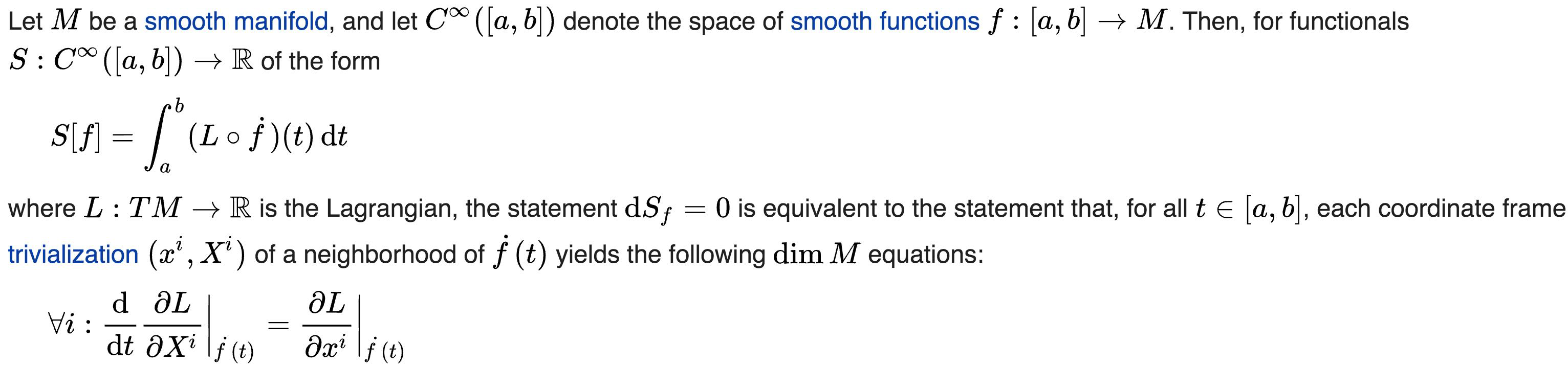
Generalization to Manifolds:
Beltrami Identity:
Beltrami Identity is a special case of the Euler Lagrange Equation where \(\partial L / \partial x=0\), defined as:$$L-f^{\prime} \frac{\partial L}{\partial f^{\prime}}=C$$
where \(C\) is a constant.
It is applied to many problems where the condition is satisfied like the Brachistochrone problem.
Notes: