Order of Convergence
-
Order of Convergence:

-
Important, Two cases of order:

- An arbitrary technique that generates a convergent sequences does so only linearly:
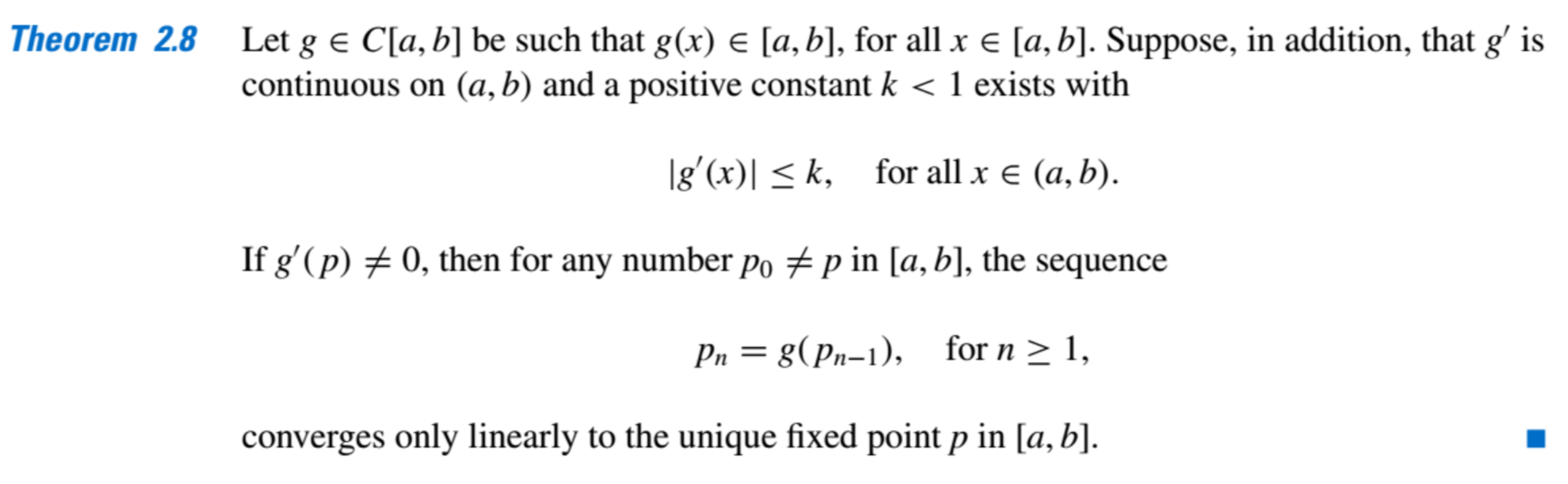
Theorem 2.8 implies that higher-order convergence for fixed-point methods of the form \(g(p) = p\) can occur only when \(g'(p) = 0\).
-
Conditions to ensure Quadratic Convergence:

-
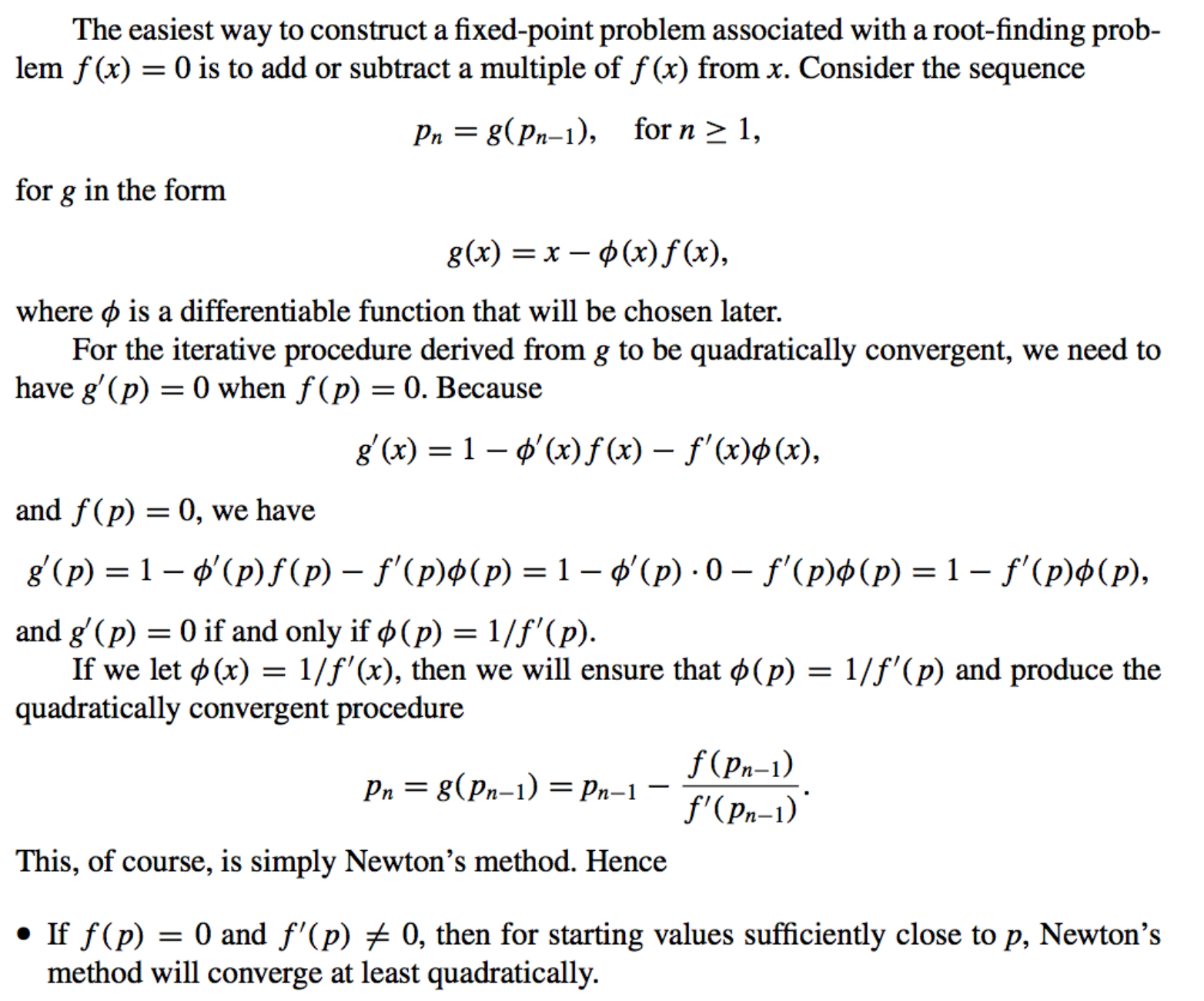
Theorems 2.8 and 2.9 imply:
(i)

(ii)

- Newtons’ Method Convergence Rate:
Multiple Roots
-
Problem:
Newton’s method and the Secant method will generally give problems if \(f'( p) = 0\) when \(f ( p) = 0\). -
Zeros and their Multiplicity:

- Identifying Simple Zeros:

-
Generalization of Theorem 2.11:

The result in Theorem 2.12 implies that an interval about p exists where Newton’s method converges quadratically to p for any initial approximation \(p_0 = p\), provided that p is a simple zero.
-
- Why Simple Zeros:
Quadratic convergence might not occur if the zero is not simpleExample: Let \(f (x) = e^x − x − 1\) Notice that Newton’s method with \(p_0 = 1\) converges to the zero \(x=0\) but not quadratically
-
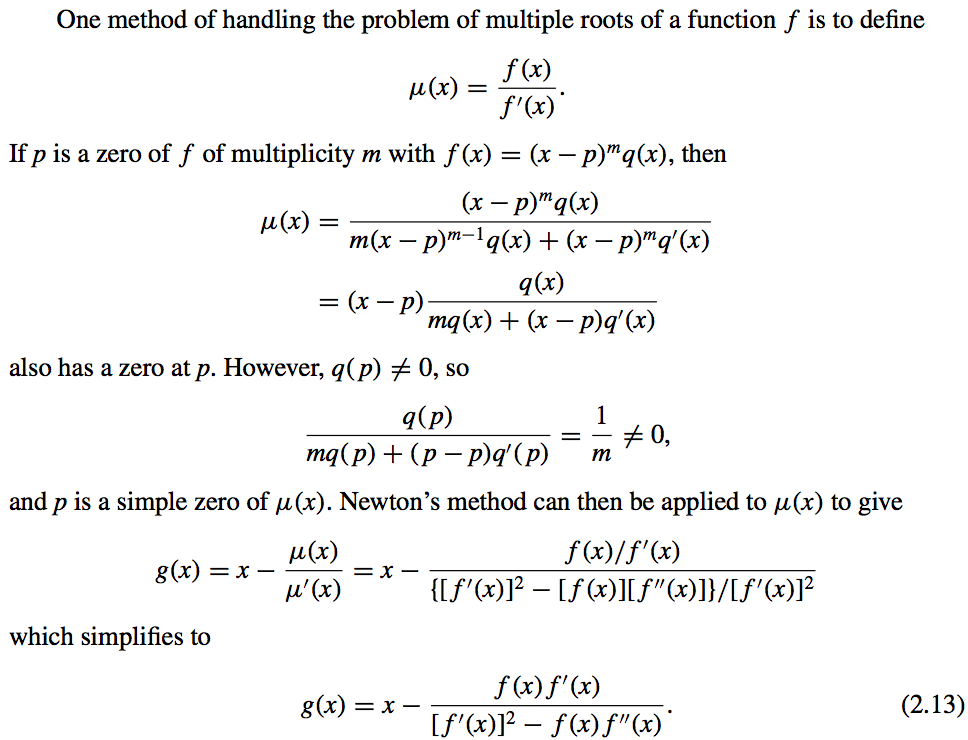
Handling the problem of multiple roots:
We Modify Newton’s Method
We define \(g(x)\) as:

- Properties:
- If g has the required continuity conditions, functional iteration applied to \(g\) will be quadratically convergent regardless of the multiplicity of the zero of \(f\) .
- Theoretically, the only drawback to this method is the additional calculation of \(f (x)\) and the more laborious procedure of calculating the iterates.
- In practice, multiple roots can cause serious round-off problems because the denominator of (2.13) consists of the difference of two numbers that are both close to 0.
- In the case of a simple zero the original Newton’s method requires substantially less computation.
- Properties: