Main Idea
-
- What?
-
- A technique that is used to determine the nodes and coefficients
for formulas that give exact results for higher-degree polynomials. - Gaussian quadrature chooses the points for evaluation in an optimal, rather than
equally-spaced, way. - The nodes \(x_1, x_2, ... , x_n\) in the interval \([a, b]\) and coefficients \(c_1, c_2, ... , c_n\), are chosen to minimize the expected error obtained in the approximation, \(\int_{a}^{b} f(x) dx = \sum_{i=1}^{n} c_i f(x_i).\)
- A technique that is used to determine the nodes and coefficients
-
-
To Measure Accuracy: we assume that the best choice of these values produces the exact result for the largest class of polynomials, that is, the choice that gives the greatest degree of precision.
-
-
-
The Coefficients \(c_1, c_2, ... , c_n\) in the approximation formula are arbitrary,
and,
The Nodes \(x_1, x_2, ... , x_n\) are restricted only by the fact that they must lie in \([a, b]\), the interval of integration.
This gives,
The number of Parameters to choose is \(2n\).
-
-
-
If the coefficients of a polynomial are considered parameters, the class of polynomials of degree at most \(2n − 1\) also contains \(2n\) parameters.
This, then, is The Largest Class of Polynomials for which it is reasonable to expect a formula to be exact.
-
-
- Why?
- The fact that, Newton-Cotes Formulas use values at equally-spaced nodes, can significantly decrease the accuracy of the approximation.
Legendre Polynomials
-
- What?
- A series of solutions to “Legendre’s differential equation” that form a polynomial
sequence of orthogonal polynomials.
-
- Why?
- The roots of the nth-deg Legnedre Polynomial are the nodes needed for the approximation formula that gives exact results for any polynomial of degree less than \(2n\).
- Properties:
- For each \(n\), \(P_n(x)\) is a monic polynomial of degree \(n\).
- \(\int_{-1}^{1} P(x) P_n(x) dx = 0,\) whenever \(P(x)\) is a polynomial of degree less than \(n\).
- The roots of these polynomials are:
- Distinct,
- lie in the interval \((−1, 1)\),
- have a symmetry with respect to the origin,
- the correct choice for determining the parameters that give us the nodes and coefficients for our quadrature method.
- The first Legendre Polynomials:
\(P_0(x) = 1, \ \ \ \ \ \ \ \ \ \ \ \ \ \ P_1(x) = x, \ \ \ \ \ \ \ \ \ \ \ \ \ \ P_2(x) = x^2 − \dfrac{1}{3},\)
\(P_3(x) = x^3 − \dfrac{3}{5}x,\ \ \ \ \ \ \ \ \ \ \ \ \ \ \ \ \ \ \ \ \ P_4(x) = x^4 − \dfrac{6}{7}x^2 +\dfrac{3}{35}.\) -
Determining the nodes:
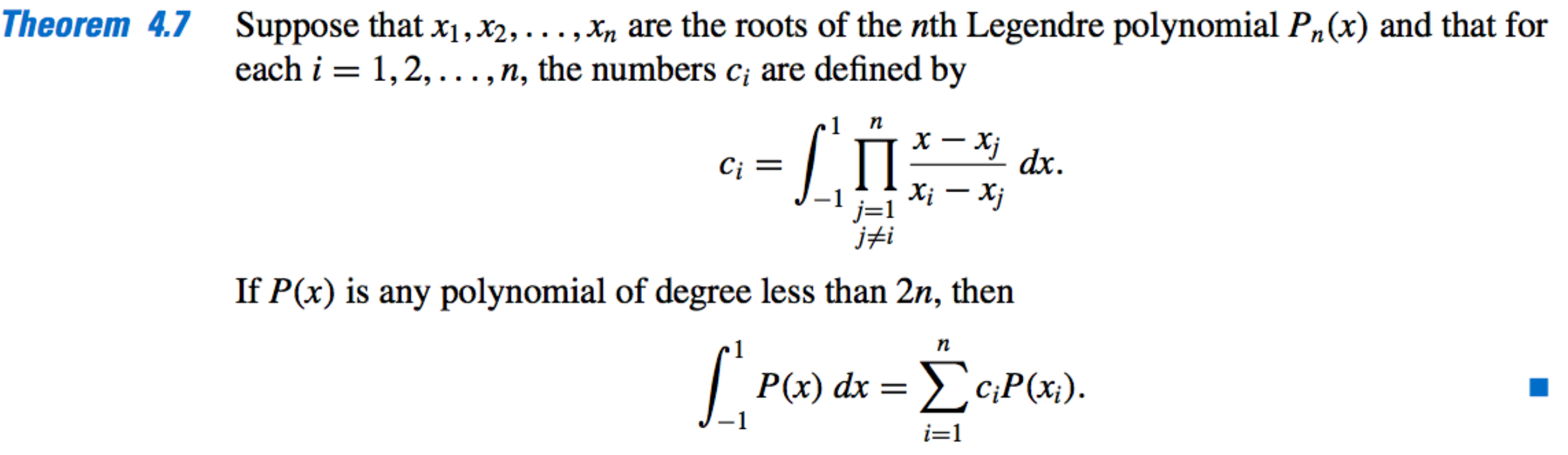
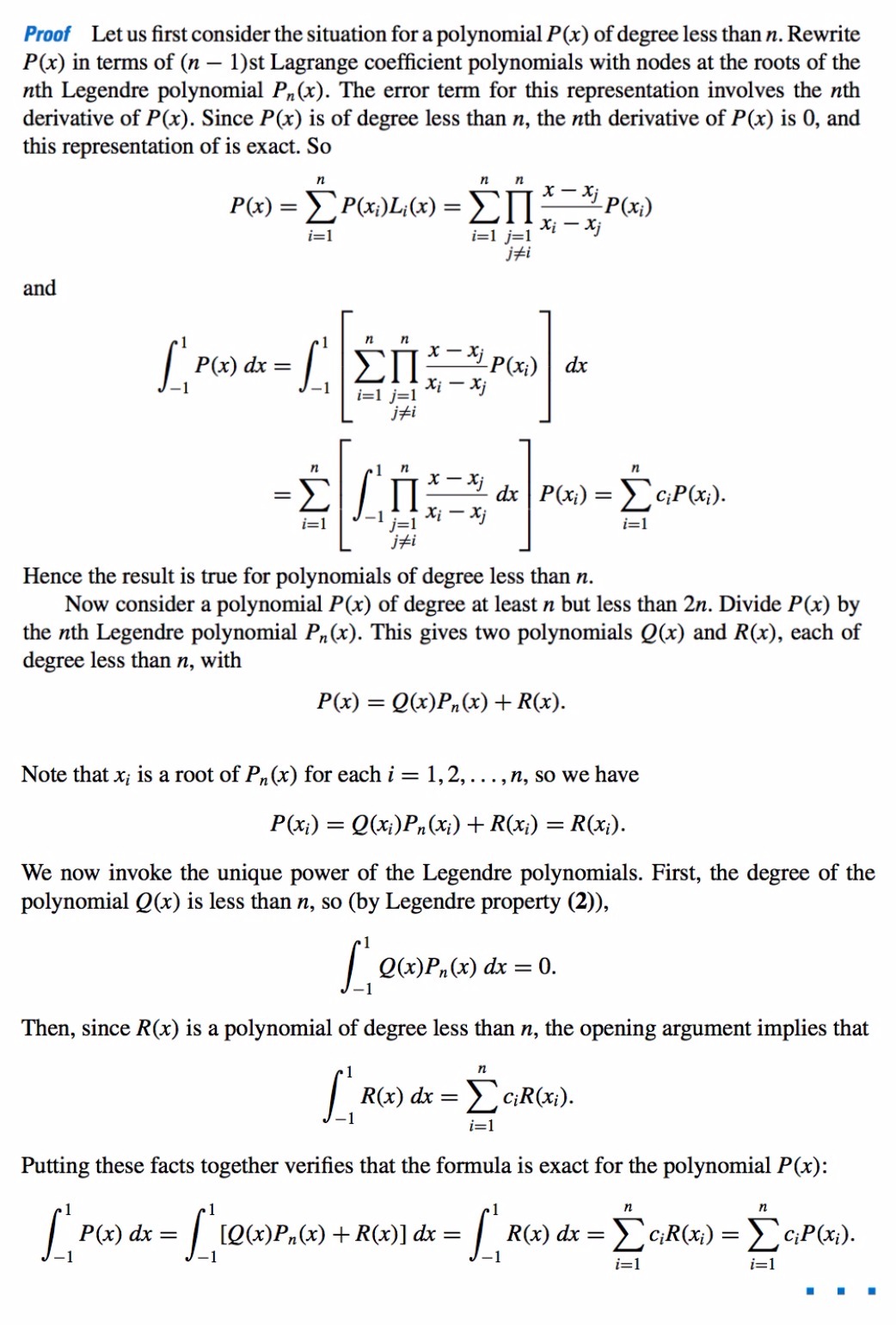
The nodes \(x_1, x_2, ... , x_n\) needed to produce an integral approximation formula that gives exact results for any polynomial of degree less than \(2n\) are the roots of the nth-degree Legendre polynomial.
Gaussian Quadrature on Arbitrary Intervals
- What?
- Change of Intervals: An integral \(\int_{a}^{b} f(x) dx\) over an arbitrary \([a, b]\) can be transformed into an integral over \([−1, 1]\) by using a change of variables.
- The Change of Variables:
\(\ \ \ t = \dfrac{2x − a − b}{b − a} \ \ \ \iff \ \ \ x = \dfrac{1}{2}[(b − a)t + a + b].\) - Gaussian quadrature [arbitrary interval]:
