Table of Contents
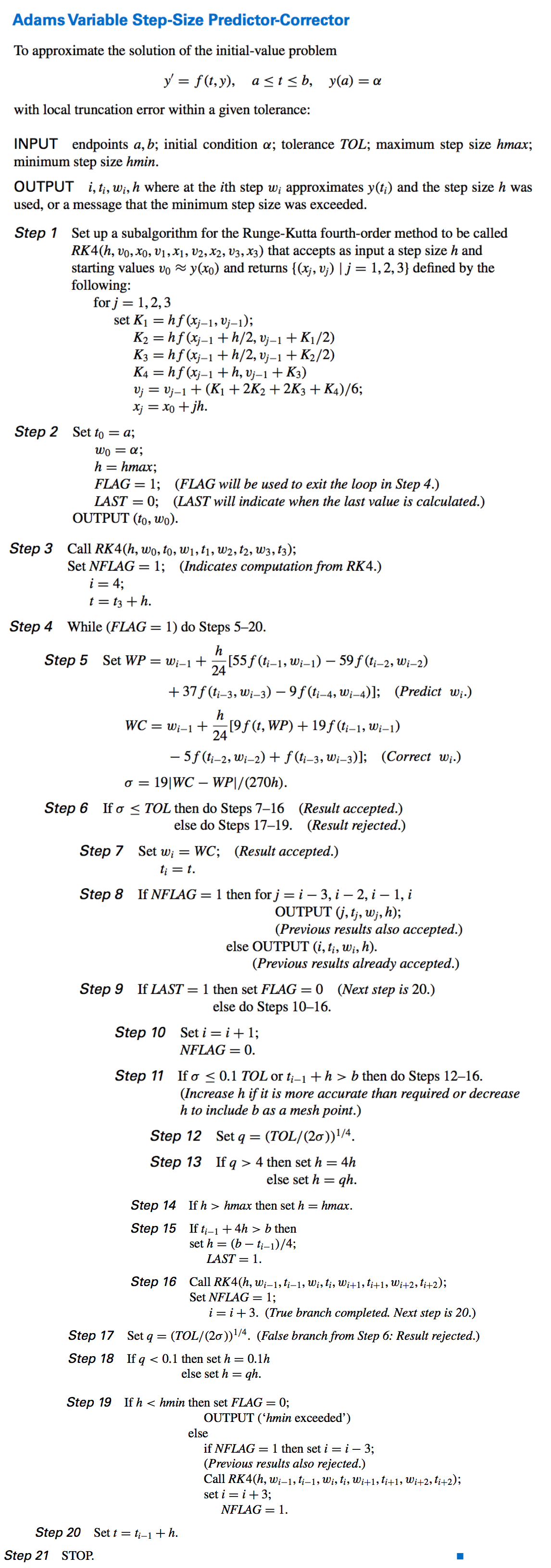
Variable Step Multistep Methods
-
- What?
- A Predictor-Corrector Method that uses variable step sizes for error control.
-
- Why?
- Predictor-corrector techniques always generate two approximations at each step, so they are natural candidates for error-control adaptation.
-
Derivation:
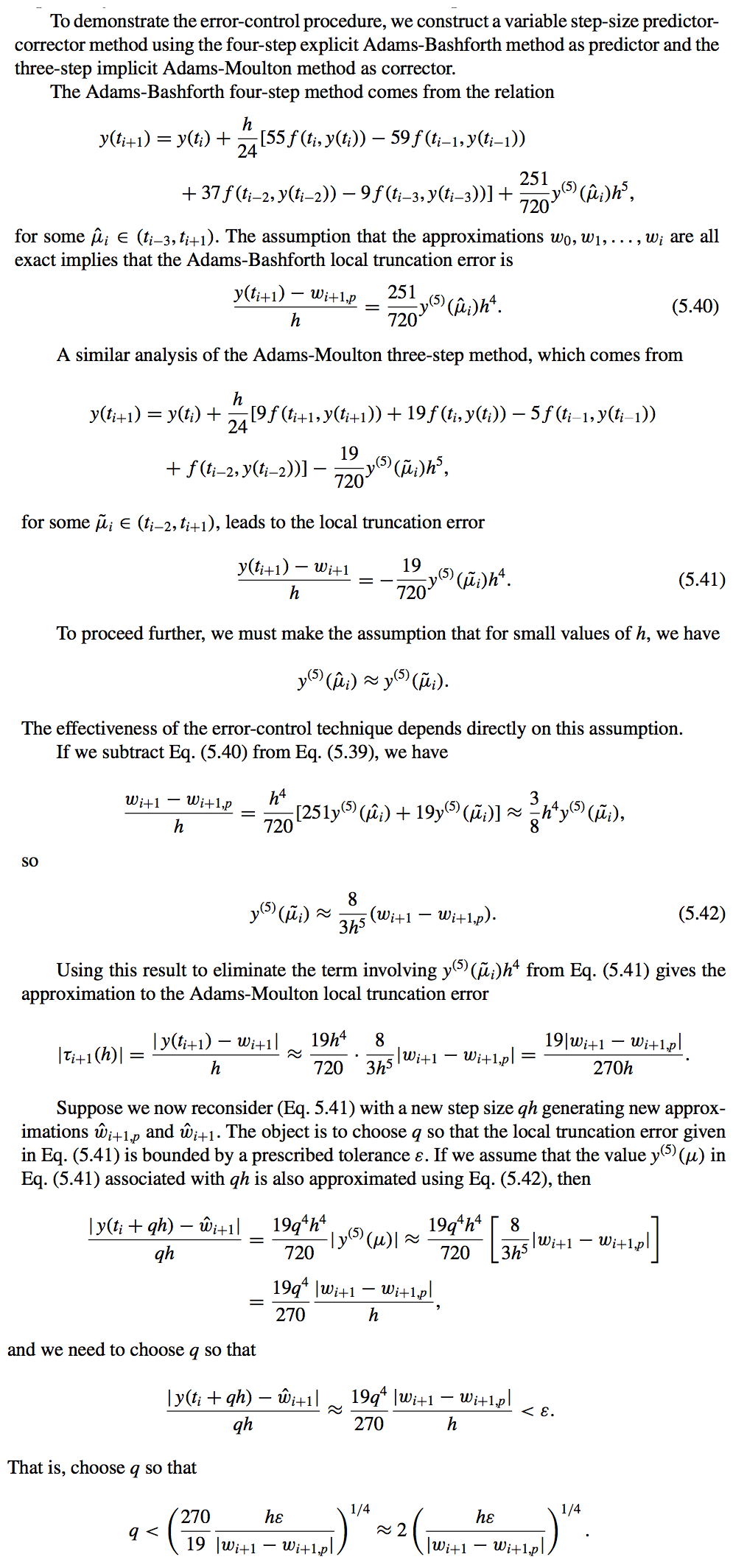
- Choosing ‘\(q\)’:
- \(q\) is, generally, chosen conservatively:
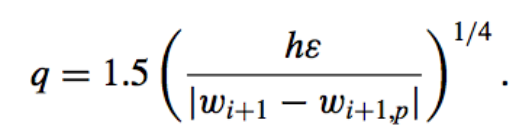
- \(q\) is, generally, chosen conservatively:
- Properties:
- A change in step size for a multistep method is more costly in terms of function evaluations than for a one-step method, because new equally-spaced starting values must be computed.
- Consequently, we ignore the step-size change whenever the local truncation error is between \(\dfrac{\epsilon}{10}\) and \(\epsilon\), that is, when

- \(q\) is given an upper bound to ensure that a single unusually accurate approximation does not result in too large a step size.
- Algorithm: